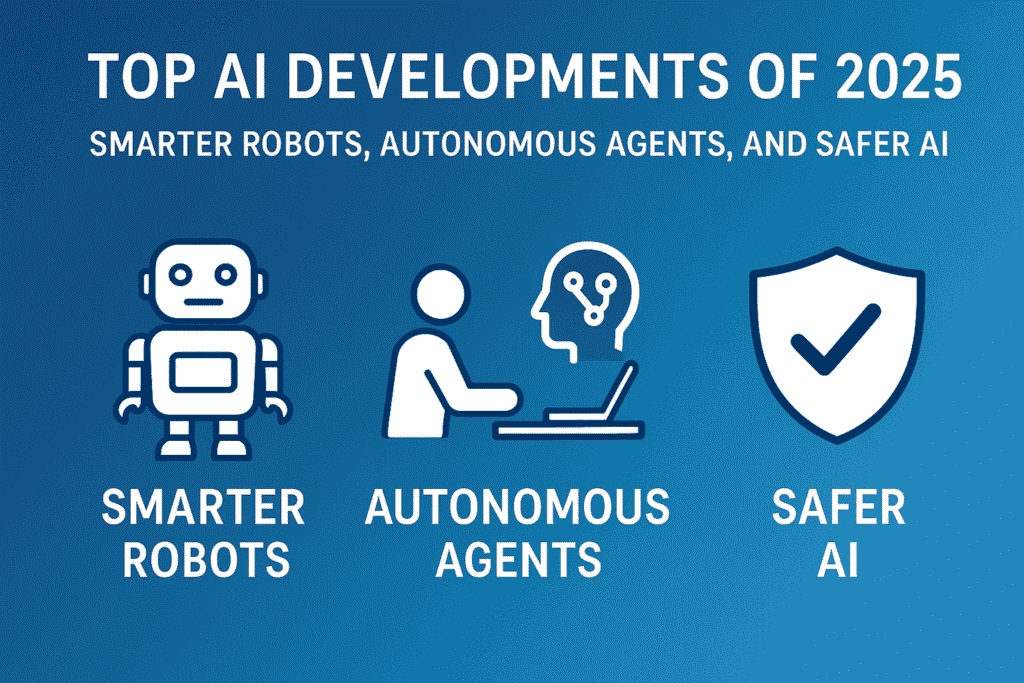

Artificial Intelligence (AI) is evolving faster than ever, and 2025 is shaping up to be a landmark year. From smarter robots and autonomous agents to advanced safety systems, AI is no longer confined to chatbots or online tools—it’s transforming the way we live, work, and interact with technology. In this article, we explore the top AI developments of 2025 that everyone should know about.
1. Smarter Robots Are Here
One of the most exciting trends in 2025 is the rise of intelligent, physical AI. AI is moving from digital screens into the real world through robotics.
- Gemini Robotics (DeepMind): Google DeepMind introduced models like Gemini Robotics and Gemini Robotics-ER that allow robots to see, understand, and act in complex environments. These robots can manipulate objects, plan multi-step actions, and adapt to new tasks without constant human intervention.
- Skild AI’s General-Purpose Robotic Brain: Startups like Skild AI are creating “brains” that can work across different robots—from humanoids to quadrupeds—allowing one AI system to control many robots efficiently.
- NVIDIA Jetson Thor: This new hardware platform brings massive processing power to robots, enabling them to run large AI models in real-time at the edge, without needing constant cloud support.
Why it matters: Smarter robots mean more automation in industries, healthcare, logistics, and daily life. Robots are no longer simple machines—they’re becoming collaborative, adaptive partners.
2. Autonomous AI Agents Are Taking Off
Another major development in 2025 is agentic AI, which refers to AI systems that can plan, act, and make decisions independently.
- Manus AI: Manus is an autonomous agent capable of completing multi-step real-world tasks without constant human oversight. Its “wide research” mode allows 100+ agents to work together, tackling complex problems efficiently.
- Human-in-the-Loop AI: Tools like ResearStudio and Magentic-UI allow humans to supervise and collaborate with AI agents, providing a balance between autonomy and control.
Why it matters: These autonomous agents are moving us closer to a world where AI can handle complex workflows, from research and problem-solving to business operations, while still allowing humans to guide and supervise.
3. AI Safety & Alignment Are More Important Than Ever
As AI grows smarter and more independent, safety and ethics have become top priorities.
- LawZero and Honest AI: AI pioneer Yoshua Bengio launched a nonprofit called LawZero to build “honest AI”. Their systems monitor other AI agents to prevent harmful behaviors, deception, or unintended actions.
- Global AI Safety Initiatives: Governments and international organizations are increasingly focusing on AI safety standards, ensuring that powerful AI systems remain controllable and aligned with human values.
Why it matters: Safety-focused AI ensures that advanced models can benefit society without causing harm. As AI agents become more autonomous, safety is no longer optional—it’s essential.
4. Multi-Modal and Next-Gen AI Models
2025 also brings more capable AI models that can understand text, images, videos, and even real-world environments.
- OpenAI GPT-5.1: Offers “Thinking” and “Instant” modes for deep reasoning and rapid tasks.
- Baidu ERNIE 5.0: A multimodal model capable of understanding text, images, and videos simultaneously, improving decision-making and reasoning.
- Inception AI Mercury: A faster, more efficient large language model with massive context windows, enabling better comprehension and planning.
Why it matters: These next-gen AI models are not just “smarter” in theory—they can interact with the real world, analyze complex data, and assist in decision-making like never before.
5. The Future of AI in 2025 and Beyond
The top AI developments of 2025 highlight a clear trend: AI is becoming smarter, safer, and more autonomous. Key takeaways include:
- AI is moving from digital-only to embodied intelligence, interacting with physical environments.
- Autonomous agents are increasingly capable of complex tasks with minimal supervision.
- Safety and alignment are becoming core pillars in AI development.
- AI models are multimodal, meaning they can handle text, images, videos, and real-world data seamlessly.
For businesses, researchers, and everyday users, these developments mean one thing: AI is no longer just a tool—it’s a partner. Whether in the form of a smart robot, an autonomous agent, or a safety-first system, AI is shaping a future that’s both exciting and responsible.
Conclusion
2025 marks a turning point in artificial intelligence. With smarter robots, autonomous agents, next-gen models, and a strong focus on safety, AI is reshaping industries and daily life. By keeping an eye on the top AI developments of 2025, we can prepare for a world where AI is more integrated, capable, and safe than ever before.